
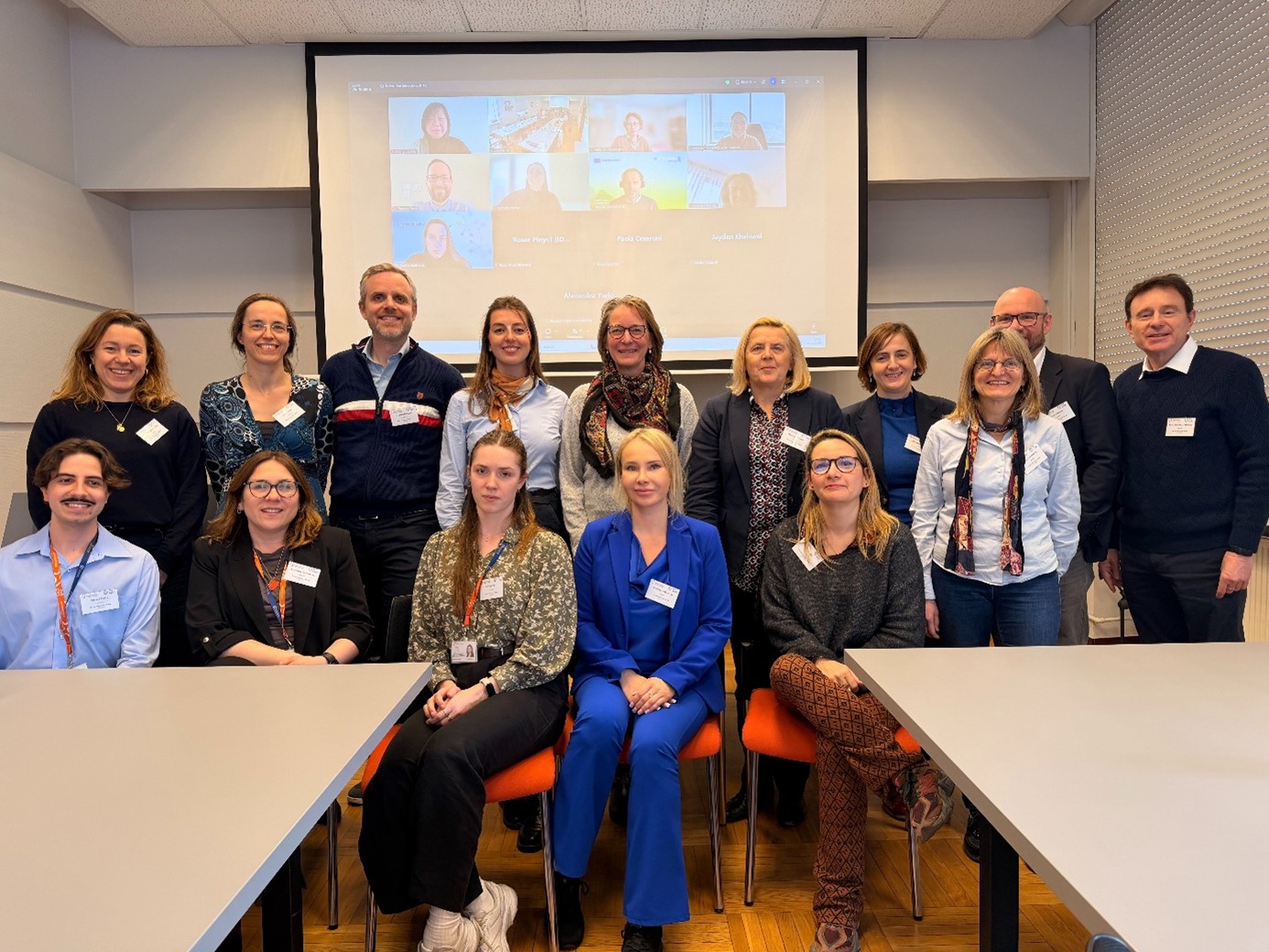
The second annual meeting of the EU Cancer Mission’s Understanding Tumour-Host Interactions Cluster (U-THI-Cluster) took place in March 2026 at the Nencki Institute of Experimental Biology, Polish Academy of Sciences, in Warsaw. Organised by the HIT-GLIO project in a hybrid format, the meeting brought together representatives from all six U-THI-Cluster projects, the European Health and Digital Ex-ecutive Agency (HaDEA), the European Commission (EC), Understanding Cancer Connect (UN-CAN-Connect) and CANDLE (an EU project to set up national cancer data nodes for cancer data). This joint press release highlights the U-THI-Cluster’s progress over the past year and shares the main takeaways from the meeting.
A shared U-THI-Cluster mission
The U-THI-Cluster brings together six EU-funded research projects: ARTURO, GLIOMATCH, HIT-GLIO, MULTIR, SPACETIME and THRIVE. Each project studies tumour-host interactions from a different angle and across different cancer types, but all share the same ambition: to strengthen scientific collaboration, support policy development and contribute to better outcomes for people affected by cancer. The U-THI-Cluster’s work is organised through six working groups focused on data management and sharing, communication and dissemination, research and innovation, addressing inequalities, citizen and patient engagement, and annual meetings and even
One year of progress
Since the first annual meeting, the U-THI-Cluster has moved from initial alignment to active collaboration. Four U-THI-Cluster deliverables have been successfully submitted: the common work plan for scientific collaboration, the common video and brochure, the conclusions of the first annual meeting, and the first policy brief. A common U-THI-Cluster chapter has also been prepared for inclusion in the Data Management Plans of the participating projects. Two further deliverables are now in preparation: the second annual report on the U-THI-Cluster meeting and the second policy brief. Together, these outputs show that the U-THI-Cluster has built a clear framework for collaboration and is turning shared discussions into practical results.
Scientific exchange across projects
The Warsaw meeting began with scientific updates from all six project representatives. The exchange show-cased the broad range of tumour types, technologies and research approaches represented in the U-THI-Cluster, while also underlining the importance of working together on shared challenges. Discussions focused on opportunities for cross-project learning and on the evaluation of potential pan-cancer markers that may be relevant across more than one cancer type.
Towards more interoperable cancer research data
Data management and sharing remained a central theme of the meeting. GLIOMATCH presented the results of a U-THI-Cluster questionnaire on data management practices, which confirmed shared challenges around ethical, legal and security requirements, data transfer agreements, and the harmonisation of data and metadata formats. The projects also identified opportunities to exchange best practices in metadata stand-ards, quality control and analysis pipelines, particularly for shared data types such as clinical data, spatial proteomics and transcriptomics. Representatives from UNCAN-Connect and CANDLE joined the discussion to explore how the U-THI-Cluster can contribute to European efforts to develop federated cancer data infra-structures.
Communication, dissemination and the first U-THI-Cluster newsletter
The Communication and Dissemination strand, led by MULTIR, reported on progress in making the U-THI-Cluster more visible. Over the past year, the projects have jointly promoted the U-THI-Cluster through social media, the common video and brochure, and participation in EU Cancer Mission dissemination activities. The U-THI-Cluster also discussed plans for a twice-yearly electronic newsletter. The first issue is planned for Sep-tember 2026 and will share updates on U-THI-Cluster activities, project progress and joint opportunities. The newsletter will offer another way to communicate the U-THI-Cluster’s work to stakeholders and increase visibility across the EU Cancer Mission community.
Research and innovation priorities
SPACETIME presented the results of a U-THI-Cluster-wide questionnaire on barriers to implementation, with contributions from all six projects. The responses highlighted challenges related to regulatory processes, data governance, clinical implementation, technical development, administrative procedures, and engagement with European and national initiatives. Based on the questionnaire results and the discussions held during the annual meeting, the U-THI-Cluster agreed that this year’s policy recommendations should focus on eth-ics-related challenges.
Next steps
The U-THI-Cluster also continued its work on inequalities and on citizen and patient engagement. The Addressing Inequalities strand, co-led by GLIOMATCH and AR-TURO, discussed barriers such as limited research on understudied populations, un-equal access to advanced therapies, the affordability of experimental treatments, bias in data collection, and the need for stronger community and policy engage-ment. HIT-GLIO also shared citizen and patient engagement activities from the past year, including public debates, lay lectures, charity and outreach activities, and par-ticipation in the EU Cancer Mission Fair. As part of the wider discussion on implemen-tation, an expert consultation led by ARTURO explored practical ways to streamline ethics and regulatory processes for EU-funded studies conducted across several countries.
- Communication and outreach: Launch of the first U-THI-Cluster newsletter and continued joint dis-semination activities
- Policy and stakeholder engagement: Joint workshop on policymaking, ethics, societal considera-tions and stakeholder engagement in autumn 2026
- EU Cancer Mission visibility: Participation in the EU Cancer Mission high-level event in Brussels from 30 September to 1 October 2026
- Data management and interoperability: Follow-up data management questionnaire and continued exchange with UNCAN-Connect and CANDLE to support more visible, useful and accessible cancer research data
- Policy recommendations: Finalisation of ethics-related recommendations and preparation of clini-cal implementation as the next priority theme for 2026 to 2027
- Citizen and patient engagement: Collection of citizen and patient engagement activities across all U-THI-Cluster projects for upcoming reporting
Stay tuned for more updates on SPACETIME’s role in the U-THI Cluster!